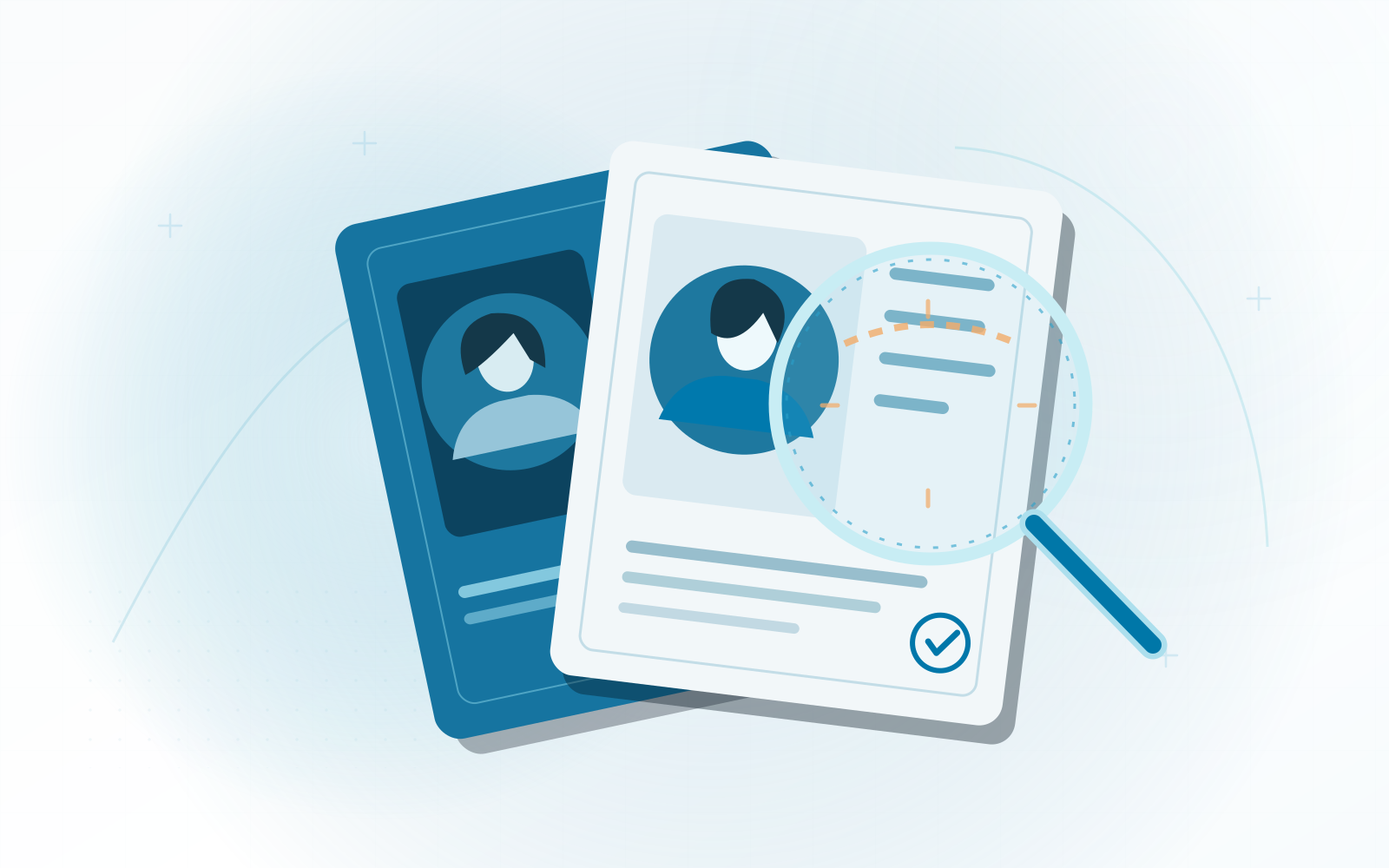
One of the questions I get asked most often is whether we can tell when a candidate is using AI to answer, or whether the person on the call is really the applicant. It comes from recruiters, HR leaders, hiring managers, and security teams, and by now it usually comes up early in the conversation.
The honest answer isn't a clean yes or no, because AI use in hiring isn't one thing. Candidates use these tools to clean up a resume, practice answers, read up on the company, and get ready for questions they think they'll be asked. Most hiring teams are fine with that, and it isn't what's causing trouble. The same tools can also write experience a candidate never had, feed them answers while the interview is running, change how they look and sound on camera, or help one person sit in for another. From the outside those two things can look the same, and they call for very different responses.
That's really the shift. A resume has always been a set of claims. What changed is how fast those claims can be made to look real, and how much harder they are to check once they're sitting in front of you.
I try not to lean too hard on survey numbers, since they move around a lot depending on who got asked. The direction is steady enough to be worth knowing. Checkr surveyed 1,000 business leaders for its Recruitment Realities 2026 report and found that 73% of companies had run into AI-written resumes, cover letters, or assessments. Nearly half, 49%, said they'd made an offer to someone who used AI to look more qualified than they were, and another 26% thought it had happened but couldn't prove it. In the same research, 62% said AI has made normal resume screening close to useless.
On the candidate side, Gartner asked 3,000 job seekers and found that 39% used AI during the application process, including 29% who used it to answer assessment questions. Six percent admitted to interview fraud, meaning they posed as someone else or had someone pose as them. Gartner also expects one in four candidate profiles worldwide to be fake by 2028. That last one is a prediction, not a count, so treat it as a direction and not a number to plan against.
A resume aimed at one specific job used to take real time and some skill. Now it takes a few minutes, and so does a cover letter, a portfolio summary, or a set of application answers. Using AI to fix grammar or tidy up real experience isn't the problem. The problem starts when AI is used to make up projects, make someone's part in the work sound bigger than it was, or list skills the candidate has never used.
That makes a resume a weaker first filter than it used to be. A candidate can match the wording of the job post closely enough to get past a keyword screen without having done any of the work those words describe. SHRM has a name for the gap between how a candidate presents their ability and what they can do, which is skillfishing. Their survey of 2,000 U.S. workers and HR professionals found that 63% had worked with someone who looked great on paper and couldn't do the job once hired.
Getting ready for an interview has always been fair game. Candidates rehearse, read up, and line up the stories they want to tell. The line gets crossed when someone leans on AI during the interview to give answers they couldn't give on their own. At that point you're grading how good the AI answer was, not what the candidate knows or how they think.
This one is easy to miss, because the answer comes out better, not worse. It's well organized and uses the right words, which is what most of us were trained to reward. Greenhouse asked 4,136 job seekers, recruiters, and hiring managers about this and found that 65% of hiring managers had caught candidates using AI to fake it somewhere in the process. One look at 19,368 technical interviews run between July 2025 and January 2026 flagged 38.5% of them for possible AI help, though that's a vendor's own detection data and a flag isn't proof. A slow connection, an accessibility need, or plain unfamiliarity with the format can all look strange too.
Either way, the gaps rarely show up in the first answer. They show up when the conversation moves past it and the candidate has to explain a decision, defend a tradeoff, or say what they'd do differently.
Some candidate fraud isn't about improving an answer at all. It's about changing who's giving it. Checkr's survey of 3,000 U.S. hiring managers found that 31% had interviewed someone who turned out to be using a fake identity, and 35% had confirmed that someone other than the listed applicant showed up for a virtual interview. Only 19% said they were very confident their process would catch a fake applicant.
Remote hiring is what makes this hard. Seeing someone on camera tells you a person showed up for the interview. It doesn't tell you the person is the applicant on the resume, that the identity is real, or that this is who'll be doing the work and holding the logins three months from now.
The tools for changing a remote interview keep getting easier to use. Voice cloning, face-swapping, and made-up faces are all within reach of a candidate who wants them, and recruiters are starting to report running into them. A survey of HR professionals reported by NextShark found that 17% of recruiters had picked up on voice cloning or voice filters during interviews, and 15% had seen face-swapping software.
I wouldn't treat any of that as proof on its own. Bad internet, a cheap webcam, sound delay, and accessibility tools cause the same kinds of glitches, and a candidate you drop over a bad video feed is a candidate you lost for no reason. When something looks off, the right move is to look closer, not to close the file.
Hiring fraud gets talked about as a recruiting problem. For the technical and technical-adjacent roles we work with, it's a security problem too, because whoever gets through the process ends up with access to internal systems, customer data, source code, financial records, company laptops, and sometimes admin logins. That's why HR and security so often end up in the same conversation about it. If the wrong person got through, you're not just starting the search over. You may be dealing with a security incident, a compliance problem, lost delivery time, and work that has to be done again.
Even without the security side, a bad hire is expensive. CareerBuilder found that 75% of employers have hired the wrong person, at an average cost of close to $17,000, and nearly half of those employers said the person's skills didn't match what they'd claimed. For engineers, IT leads, and customer-facing technical staff, the real cost runs higher once you add lost ramp time, rework, missed dates, extra manager time, and pulling your experts back in to fix something that should have been caught in the first round.
The answer isn't to treat every candidate like a suspect. Most of them are doing exactly what they've been told to do, which is prepare well. The answer is to ask for better proof earlier, and when teams ask me where to start, these are the five things worth getting proof on.
Identity. Is this the person they say they are? For the roles and stages where it makes sense, identity checks work better tied together across the process than done once at onboarding. That can mean identity verification, checking past jobs and credentials, and making sure the person who interviewed is the person who ends up with access to your systems.
Experience. Can the candidate explain the work on their resume? Broad questions get broad answers, and a rehearsed answer clears a broad question easily. Ask what they decided themselves, what the team turned down and why, what went wrong, how the result got measured, and what they'd change if they ran the project again. That's the kind of thing a generated answer struggles with. Specific answers are proof. Smooth answers aren't.
Knowledge. Does what they know go deeper than the first answer? Follow-up questions tied to the role make it harder to pass off a memorized or generated answer as real understanding. Someone who used AI to prepare can still explain the idea, defend the choice, and handle a harder question. Someone reading from a script tends to lose the thread as soon as the conversation moves past what was written for them.
Reasoning. Can they explain how they got there? Knowing the right answer matters, and knowing how someone got to it tells you more about how they'll handle work you haven't seen yet. Look for judgment, tradeoffs, how they set priorities, and how they change course when the situation does.
Applied skill. Can they do something close to the actual job? For technical roles that might be debugging, reviewing code, talking through an architecture decision, changing something that already exists, or walking you through a work sample. For customer-facing and support roles it might be working through a real issue, handling a difficult customer, or explaining a decision they'd have to defend to a client. The exercise should look like the work, and the point is to watch someone do the job, not to put one more hurdle in front of them.
Interviewers notice things. An answer sounds rehearsed, someone struggles on follow-ups, something about the video seems off. Those are worth acting on, and they're a good reason to dig further. The trouble starts when they become the reason for the decision, because gut feel misses in both directions. Careful faking can slide right past it, and good candidates get marked down for nerves, an accent, an accessibility need, a bad connection, or just not being used to video interviews.
A stronger process lines signals up against each other instead of trusting any one of them. Resume claims get checked against what the candidate can explain. Interview answers get checked against practical work. Identity gets confirmed at more than one point. Technical answers get checked against whether the person can walk you through the decision behind them. Scores get checked against what the candidate actually said. An IP address, a long pause, or a weird video frame shouldn't decide whether someone gets hired, though any of them is a fine reason to check something before moving on.
Keeping AI out of hiring isn't realistic, and for a lot of roles it isn't what you'd want anyway, since plenty of the people you hire will use AI in the job. The better question is where help ends and faking starts, and that's worth settling before the interview instead of during an argument afterward.
Most teams I work with land somewhere in this range:
Writing it down does two things at once. Candidates get a fair shot at following rules they can actually see, and you end up with a process you can explain if a hiring decision ever gets questioned.
Right Hire runs a structured first-round interview built around the role, asks role-specific follow-up questions when an answer needs pushing, and checks for identity and interview integrity issues alongside the candidate's actual answers. Your team gets the recording, transcript, scorecard, and supporting evidence before deciding who moves forward, so you can look at how someone was rated instead of taking it on faith. The hiring decision stays with your team.
I'm careful about how I describe this in demos, because none of it replaces background checks or the identity and security controls you already run, and no screening process can promise fraud will never get through. Any vendor telling you otherwise is worth a harder look. What an earlier structured screen does is move the first real check of skill and identity ahead of the point where hiring managers and subject-matter experts start spending their time. When The Functionary made that change, they cut the time spent scheduling and running early interviews by about 70%, cut hiring cycles in half, and doubled accepted offers.
AI is part of how candidates apply and prepare now, and that isn't going back. Most of that use is fine. The part worth worrying about is when AI is used to cover a gap, supply answers during an interview, or put someone in front of the camera who isn't the person you're hiring. You don't have to assume the worst about candidates to deal with it. You do have to stop treating a polished resume and a confident first interview as proof, and start collecting real evidence early enough that it's useful to you.
Day to day that means asking questions tied to the real work, following up until the answers get specific, checking identity where the job calls for it, keeping a record of what the candidate said, and leaving the call to a person who can look at all of it. A hiring manager should be able to see why a candidate was rated the way they were, and a candidate who doesn't move forward should have been judged on more than how good they sounded.
Table of contents
Replace early interviews with structured evaluations, so your team sees qualified candidates sooner with clear supporting evidence.