

We get asked a lot what the best fit for anAI interview is and where they don’t work. In this post, we address the first question.
AI interviews make sense in a lot of scenarios. They can help recruiting teams extend their reach, move candidates faster, and better qualify candidates through structured interviews. Some simple examples include a recruiter who needs to fill 30 roles in the next 90 days and has received over 1,000 applicants, a development manager who is looking for a developer to help with a project that requires new technical expertise or store managers that have to constantly fill and refill front-of-the house positions. In all three cases, teams are trying to schedule and evaluate a lot of candidates with limited time and still understand whether the people they move forward will perform once hired.
These examples may appear different, but they share many of the same underlying hiring challenges. Hiring managers are overloaded with resumes, scheduling interviews is time-consuming, good candidates can move on as a result, interviewing at scale across roles and timezones can require multiple recruiters which lead to inconsistent results and evaluations. All of this, in the end, contributes to longer hiring times andhigher turnover rates.
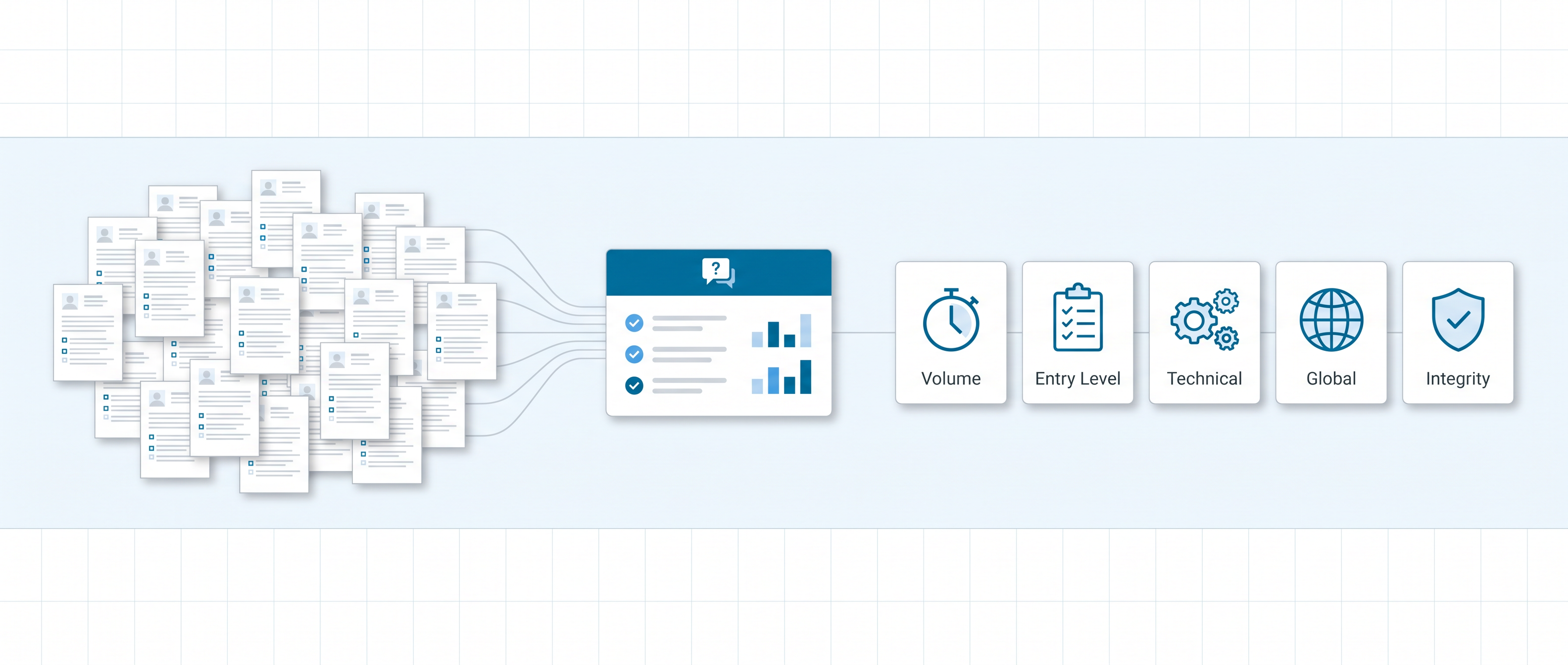
That doesn’t mean every interview should be automated. Below are the five areas where we see clients getting the biggest value out of AI structured interviews.
There comes a point when having a lot of good applicants stops being a good problem and starts becoming a triage issue.You may have 20 or 30 resumes that look strong for one role, or you maybe trying to fill 10 or more openings at the same time. Either way, someone still has to decide who moves forward, and that gets harder as volume increases.
How do you decide who to cut? No matter the decision process, chances are you are going to end up missing strong candidates, but you can’t speak to everyone because there are just not enough hours in the day for recruiters to interview everyone. In addition, if you douse multiple recruiters, questions, follow-ups and evaluation can start to vary from one recruiter to the next. The challenge is finding a way to give more qualified applicants a first look without overloading recruiters.
By using AI structured interviews, you can interview more qualified candidates without overwhelming recruiters, and each candidate goes through the same role-specific first-round evaluation. This gives recruiters more information on who is the most qualified, moves candidates though first-round screens faster, and gives recruiters more time to focus on the best candidates.
We saw this at The Functionary. After adding Right Hire to its early-stage hiring process, the company reported about a 70% reduction in time spent scheduling and conducting early-stage interviews and needed about 40% fewer candidates to meet hiring targets.
You’re hiring entry-level roles and in many cases all you have is an application. Maybe there is a short resume, but there may not be much work history on it. Yet someone still has to decide which candidates are worth bringing in for an in-person interview.
With so little information to go on, that first decision can start to feel a little like picking a number out of a hat.Managers end up interviewing a lot of people just to learn the basics: how they communicate, whether they understand the job, how they handle a customers situation, and whether they seem like someone who can be successful in the role. In a high-volume environment, that can eat up a lot of manager time while still giving you very little information before the interview.
AI structured interviews give managers more to work with before deciding who they want to meet. Every applicant can answer the same job-related questions, even if they don’t have much work history or a detailed resume. The manager goes into the in-person interview knowing more about the candidate and can spend that time going deeper instead of starting from scratch.
This is also one of the areas where there is good outside research. Brian Jabarian of the University of Chicago Booth School of Business and Luca Henkel of Erasmus University Rotterdam studied more than 70,000 applicants for entry-level customer service roles. The employer intentionally did little to no screening before the interview, so the interview itself was the main way recruiters learned about candidates.
Applicants assigned to AI-led interviews were12% more likely to receive a job offer, 18% more likely to start the job, and16% to 18% more likely to still be employed through the first four months. Human recruiters still reviewed the interviews and made the hiring decisions.The researchers found that the AI interviews followed the interview structure more consistently while still adapting questions and follow-ups based on candidate responses.

For technical hiring, the idea is pretty simple. Standardize the pre-screen so the basics are covered, then use the in-person interview to explore the areas that need a real conversation.
Recruiters can usually tell whether someone has the right experience on paper, but it’s much harder to know if they have the technical chops to do the job. A recruiter can only validate so much on a call, then it comes down to either testing, talking to a SME or both. When SMEs start getting pulled into early interviews just to make sure the candidate has the basics, hiring windows get extended and more expensive.
AI structured interviews can help offload the work of an SME and provide validation of skills earlier in the process.Candidates can all be asked the same role-specific questions, with follow-ups when an answer is unclear, and evaluated against defined criteria tied to what they said. That gives recruiters and hiring managers more information before deciding which candidates to move forward to face-to-face interviews.
The US Office of Personnel Management recommends structured interviews because using consistent job-related questions and common rating standards improves reliability and agreement between interviewers.
The Functionary saw this play out in its own technical hiring. Its technical hiring cycle went from 38 days to 13 days, while hiring managers reported better alignment between candidates who cleared the structured screen and the people they wanted to interview.
Global hiring can get complicated fast once recruiters and candidates are working across different time zones. A candidate may be available when the recruiter is asleep, hiring managers may be working from different regions, and once multiple recruiters get involved, the same role can start being screened a little differently depending on who handles the first interview.
On-demand AI structured interviews can take alot of that scheduling work out of the process. Candidates can complete the first-round interview at a time that works for them, without waiting for a recruiter's calendar to open. At the same time, everyone applying for the same role is still being asked the same questions and evaluated against the same criteria.
For remote roles, hiring teams are no longer just being asked to find someone who can do the job but also to validate that the person is who they say they are. With stolen identities, proxy interviewers, deepfakes, voice spoofing, and AI-assisted answers, it’s getting harder to know who you are really talking to.
This isn’t just a theoretical concern. Gartner reported in 2025 that 6% of 3,000 job candidates surveyed admitted to interview fraud, including posing as someone else or having someone else interview for them. Gartner also predicts that one in four candidate profiles worldwide could be fake by 2028.
For employers, the risk now goes beyond making a bad hire. If someone gets through the process using a false identity or outside help, the company may eventually be giving that person access to internal systems, customer data, source code, or other sensitive information. For remote workers, candidate screening is starting to become part of the security process too.
AI structured interview tools like Right Hire can help with both. Along with evaluating whether the candidate has the skills for the role, Right Hire checks for identity and interview integrity issues that may need a closer look. That gives the hiring team more information before the candidate moves further into the process.
It still doesn’t replace background checks or a company’s normal identity and security controls. But it does give hiring teams one more place to catch a problem before a candidate gets much further along.
Across these five scenarios, AI interviews are doing the same basic job: giving the hiring team more useful information before they commit human interview time. For a recruiter with 1,000 applicants, that means getting through the first screen without spending hours scheduling and hosting candidate pre-screens. For a store manager, it means having more than an application to go on before they bring someone in for a face to face and getting to the best candidates faster. For a technical hire, it means the basics have already been covered before an SME gets involved. And for remote hiring, it adds another place to check whether something about the candidate or interview needs a closer look.
That is where AI structured interviews tend to fit best in the hiring process. They can sit after an application or resume review and before the recruiter, SME, hiring manager or in-person interview. In entry-level hiring, where there may be very little information on the application, the AI interview may become the first real evaluation.
Human interviews are still going to be part of the process for many roles, but they become more useful when the basic screening work has already been done. Hiring managers can spend more of that time exploring experience, judgment, team fit and the areas that need a real conversation instead of repeating the same first-round questions.
How much of the process you automate will depend on the role and the hiring model. The five examples above are where we are seeing the clearest fit:situations where teams need more reach, more consistency or better information earlier while keeping the final hiring decision with people.
Table of contents
Replace early interviews with structured evaluations, so your team sees qualified candidates sooner with clear supporting evidence.